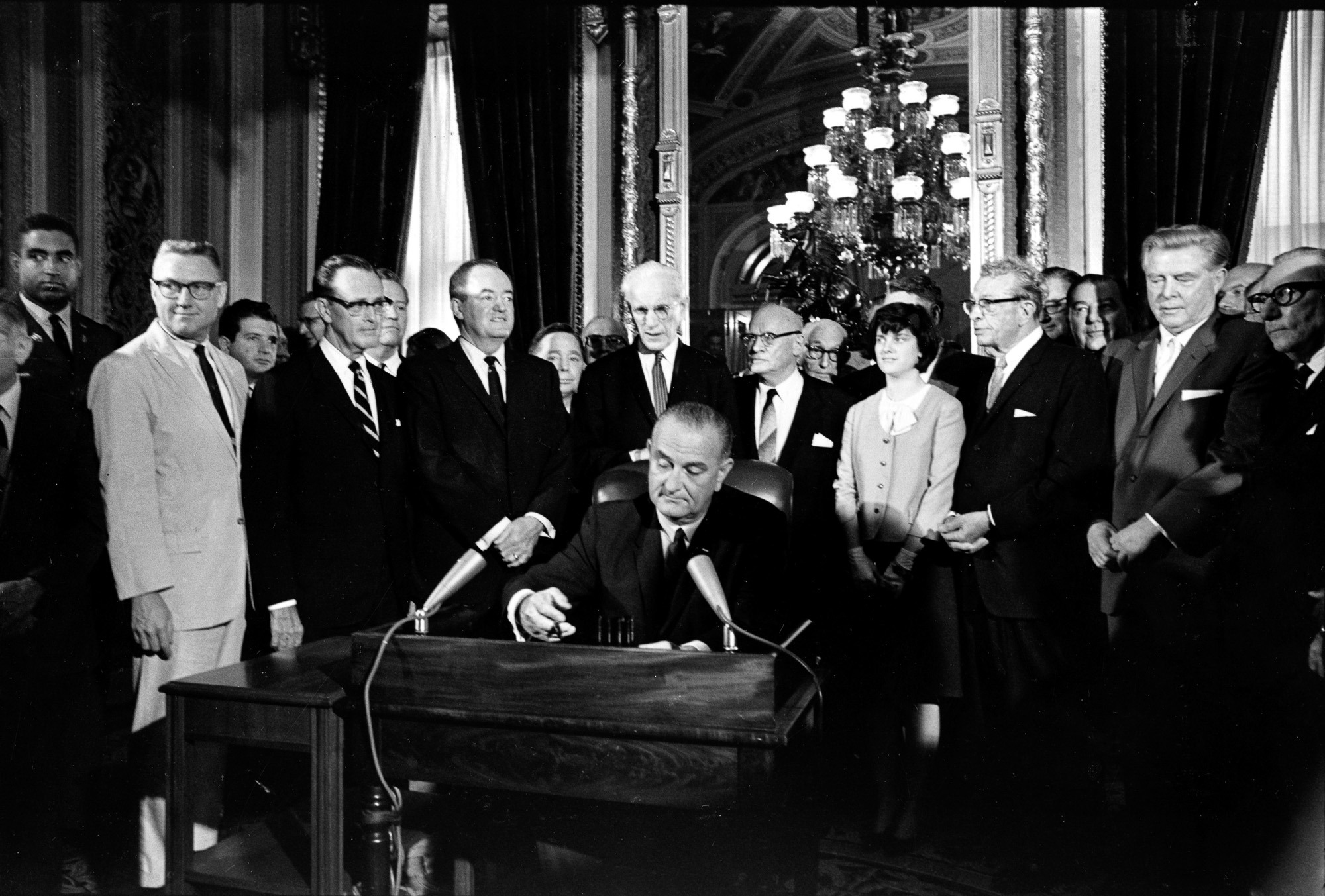
In this Aug. 6, 1965, photo, President Lyndon B. Johnson signs the Voting Rights Act of 1965 on Aug. 6, 1965, in a ceremony in the President's Room at the U.S. Capitol Washington. Surrounding the president from left directly above his right hand, Vice President Hubert Humphrey; House Speaker John McCormack; Rep. Emanuel Celler, D-N.Y.; first daughter Luci Johnson; and Sen. Everett Dirksen, R-Ill. Behind Humphrey is House Majority Leader Carl Albert of Oklahoma; and behind Celler is Sen. Carl Hayden, D-Ariz. (AP Photo)
Advertisement
African Americans were guaranteed the right to vote when President Lyndon B. Johnson signed the Voting Rights Act on August 6, 1965. The bill banned restrictions that were designed to deny Blacks their right to vote in federal, state, and local elections.
President Lyndon B. Johnson shakes hands with Martin Luther King Jr., after presenting a pen to the civil rights leader after Johnson signed the voting rights bill at the Capitol in Washington, Aug. 6, 1965. At center is Rep. Ray Madden, D-Ind. Joel Finkelstein was an accidental witness to one of the seminal events during the Civil Rights Movement, the signing in 1965 of the Voting Rights Act. He was a year out of law school when he received the call to head to the U.S. Capitol for the signing. He had helped write the law as a lawyer in the Justice Department’s Civil Rights Division. (AP Photo)
At the polls, potential voters were often told by election officials that they had gotten the date, time, or polling place wrong, that the officials were late or absent, that they possessed insufficient literacy skills, or that they had filled out an application incorrectly.
President Lyndon Johnson, at podium, speaks in the rotunda of the Capitol in Washington, D.C., prior to signing the African-American Voting Rights bill, Aug. 6, 1965. (AP Photo)
Decades after the signing of the Act, controversy still surrounds voting rights after Shelby County v. Holder gutted the Voting Rights Act.
President Lyndon Johnson, speaks in the rotunda of the Capitol in Washington, D.C., prior to signing the African-American Voting Rights bill, Aug. 6, 1965. (AP Photo)
Clay Cane is an award-winning journalist, writer, radio host, and political commentator. A graduate of Rutgers University with a degree in African-American Studies, his work on race, culture, and politics have appeared in national publications, including the Washington Post, CNN, and The Grio. Clay is a regular political commentator on MSNBC.