It was late on a school night, and instead of studying for my Spanish test in the morning, I was reading a Spawn comic book and blasting my boombox radio from the window. I was deep into the storyline, but I became distracted by an image of The Notorious B.I.G.’s “Big Poppa” video on my TV. I dropped my book, turned off the radio, and grabbed the remote to raise the TV volume. Since we were too broke for cable, I feared BIG being on the Ten O’clock News wasn’t positive. Unfortunately, I was right.
The words from legendary Detroit newswoman Amyre Makupson’s froze me, “Rapper, the Notorious B.I.G., was shot and killed leaving a Soul Train Awards show afterparty in California.” The date was March 9, 1997, and it was the second time in my life that my eyes watered for a man I had never met. The first time was six months prior when Tupac Shakur was murdered by gunfire on the Las Vegas strip. Now two of my favorite Hip Hop artists were gone, and all I could think was, “What now?!!”
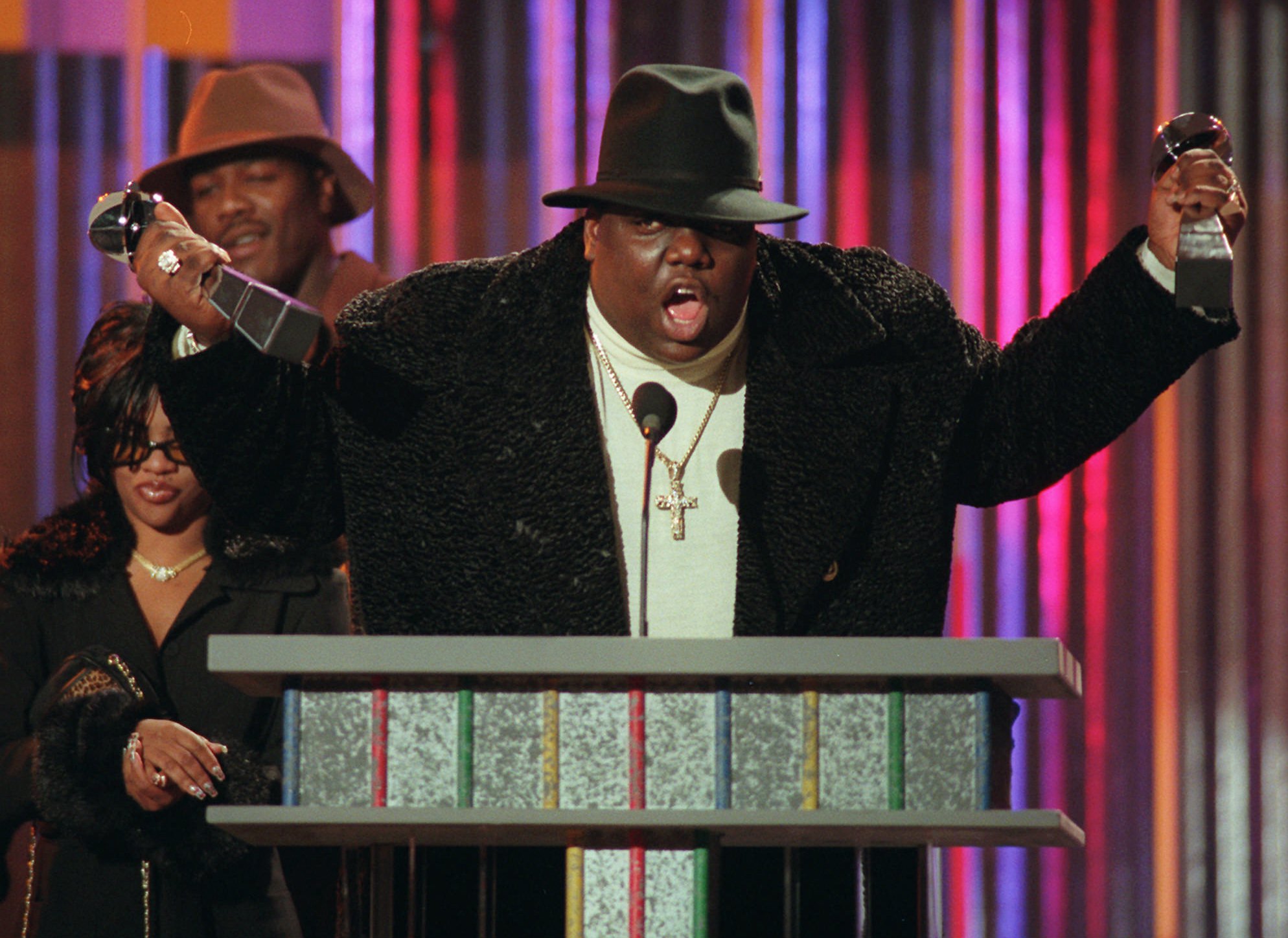
In just three short years, good music and controversy had created massive hype for the Notorious B.I.G.’s second album’s announcement. After building street buzz with mixtape freestyles and Unsigned Hype, Brooklyn’s son Christopher “BIG” Wallace was sitting on top of the world with the release of his 1994 debut album Ready to Die. He was backed by CEO of Bad Boy records, Sean “Puff” Combs, the young, brash, and flashy mogul-in-the-making who orchestrated the match of BIG’s gritty street rhymes with samples of smooth 80’s R&B. The production created a winning formula for radio play, with songs such as “Juicy”, “Big Poppa”, and “One More Chance (remix).”
The album’s darker side satisfied the Hip Hop street fan who loved records such as “Warning”, “Unbelievable”, and “Everyday Struggle.” BIG’s personal life was also catching newsworthy attention, from his messy marriage to labelmate singer Faith Evans to public fallout with a former friend turned adversary, Tupac Shakur, which geared up an East/West Coast rivalry among their peers. The Life After Death album was announced as a follow-up, and everyone, including BIG himself, was excited for its release. He couldn’t wait to get love from fans once they saw how much he’d grown as an MC. Sadly, he never got that opportunity.
The entire day of March 25, 1997, I walked around school with my ears shut, intentionally ignoring any praise or criticism from classmates who had already heard Life After Death. The album’s buzz was significant in the city, thanks to BIG’s shoutout in the lead single “Hypnotize”, where he spits, “Pink gators/ my Detroit players!,”—plus, word got around that shortly before his demise, BIG visited the city. There was even proof: a signed, autographed photo in the popular downtown clothing store called The Broadway.
Once class ended at 3pm, I rushed with Flash-speed to the Sam Goody music store in Northland Mall to spend my after-school part-time job money on the double CD. Besides the album’s cover slightly haunting me to see BIG dressed up in all-black standing next to a funeral hearse, I quickly ripped the plastic wrap off (almost scratched the CD) and forced it into the player. For the remainder of the year, my world became all things Life After Death.
Life After Death (LAD) wasn’t just a morbid title for the Notorious B.I.G.’s second coming, it was also the album’s theme. The prelude is a continuation of a skit from Ready to Die. The debut album concludes with BIG shooting himself. There’s the sound of a hospital ventilator backed by Sean “Puff” Combs’ voice pleading for BIG to make it; then, a drum baseline transitions into “Somebody’s Gotta Die”, the first song on LAD. BIG’s flow had graduated from the Thug-Life, angry yelling he had done in the past to an evolved, smooth yet crisp, calm rhyme flow—a mafioso Don style.
Just because the approach was smooth, doesn’t mean mic-wise BIG had gone soft. Enter “Kick in the Door”, a verbal assault on fellow New York rival MCs Raekwon, Ghostface Killah, Jeru Da Damaja, and Nas. “Your reign on the top was short like leprechauns,” BIG rhymed, responding to all subliminal disses heard the last few years from those upset at his “King of New York” cover for The Source Magazine. Like its lyrics, the production of LAD was top tier. Many beats were created by Bad Boy’s in-house producer squad, the Hitmen, while other tracks were developed by legends such as Easy Mo Bee, Havoc, and DJ Premier.
BIG, always the Brooklyn MC, felt it was important to show his diversity by making songs with artists who lived outside of New York, such as Too Short on “The World Is Filled” and “Notorious Thugs” featuring Bone Thugs-n-Harmony, where BIG successfully imitates the group’s signature speed while taking a lowkey shot at 2Pac (“So-called beef with you-know-who?!!”).From commercial hits like “Mo’ Money Mo’ Problems”, “Going Back to Cali”, and “Sky’s the Limit” to the street supremacy of “What’s Beef”, “Ten Crack Commandments”, and “N****z Bleed”, the Life After Death album didn’t just live up to its hype—it buried it.
That album did not have one skippable track on either CD, but “You’re Nobody (Til Somebody Kills You)” is the one I kept on repeat forever. It felt beyond coincidence that it was the last song on the album. For me, this was the Notorious B.I.G.’s actual warning, a self-eulogy to his family, friends, and fans to be heard as a prophetic message—each lyric describing the feelings of young Black adult males and teens like me who felt that the world only paid attention to us when we were murdered. On a personal level, BIG’s success came with an increased paranoia that someone was out to kill him. When he rapped, “You can be the sh!t/ flash the fattest five, have the biggest d***/ but when your shell gets hit. You ain’t worth spit/ just a memory,” I wholeheartedly believed him but hated it had to be true.
Twenty-six years later, Life After Death still reigns supreme. It solidified the Notorious B.I.G. as arguably one of the greatest ever to do it in Hip Hop. The album became an example of MC-ism, diversity, and artistry growth. There’s not a cookout crowd alive that won’t respond loudly to “B-I-G P-O-P-P-A/ No info for the DEA,” nor a Spades game that won’t bring up which New York Knick was robbed in real-life by BIG. Despite the Notorious one’s brief lifespan, Life After Death is a timeless classic with a legacy that will never die.